
Pristina, 13.06.2019
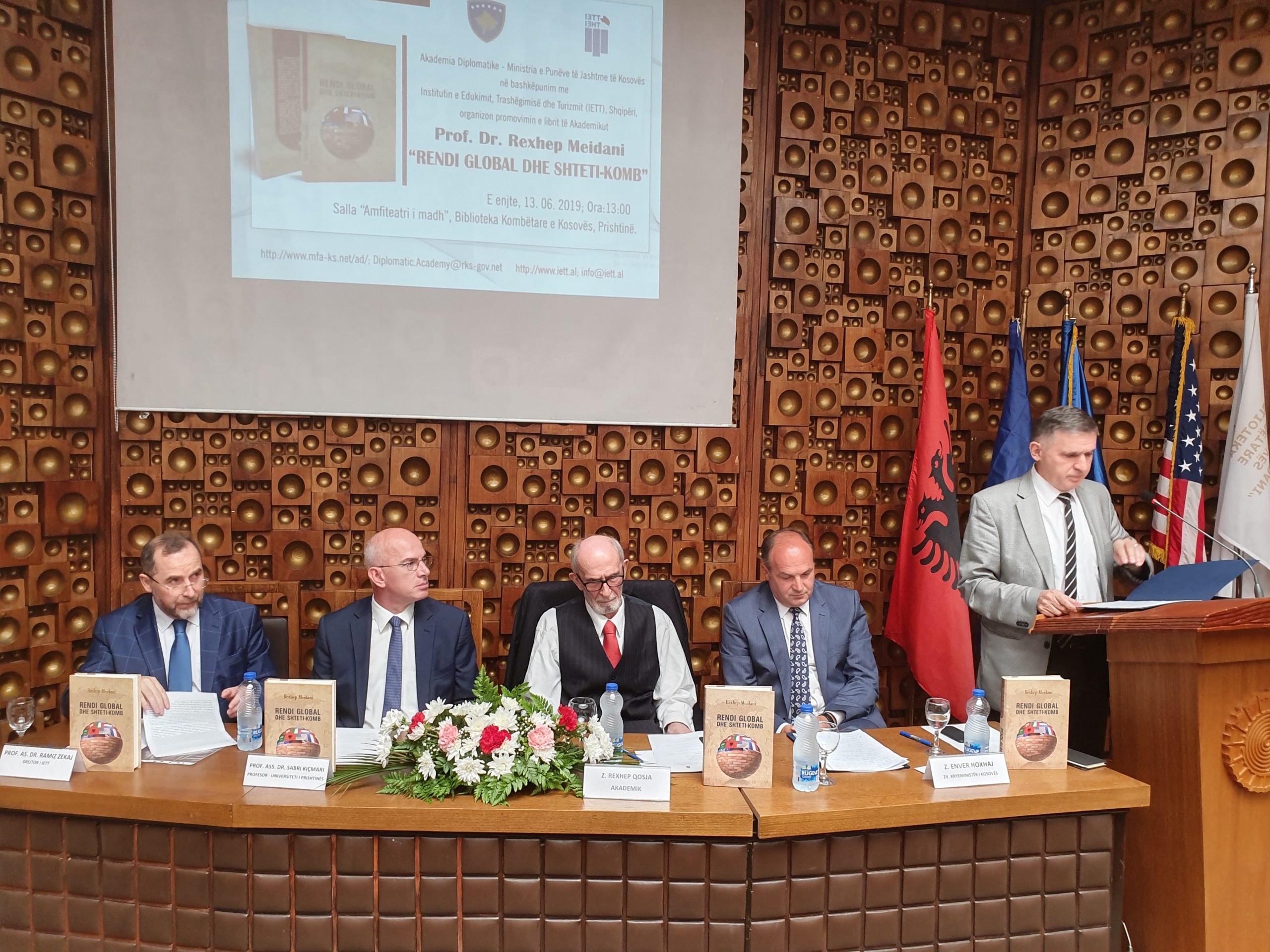
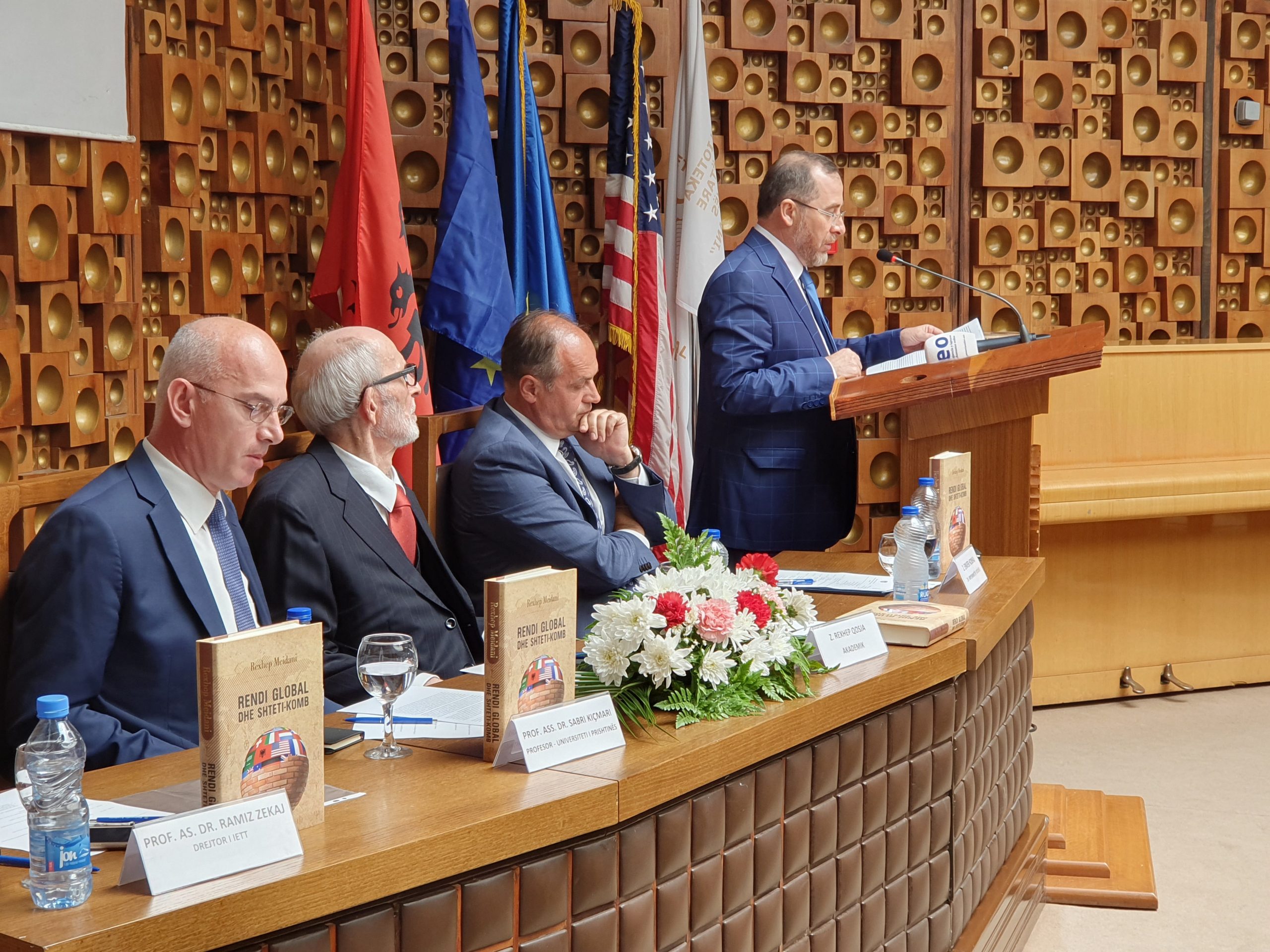
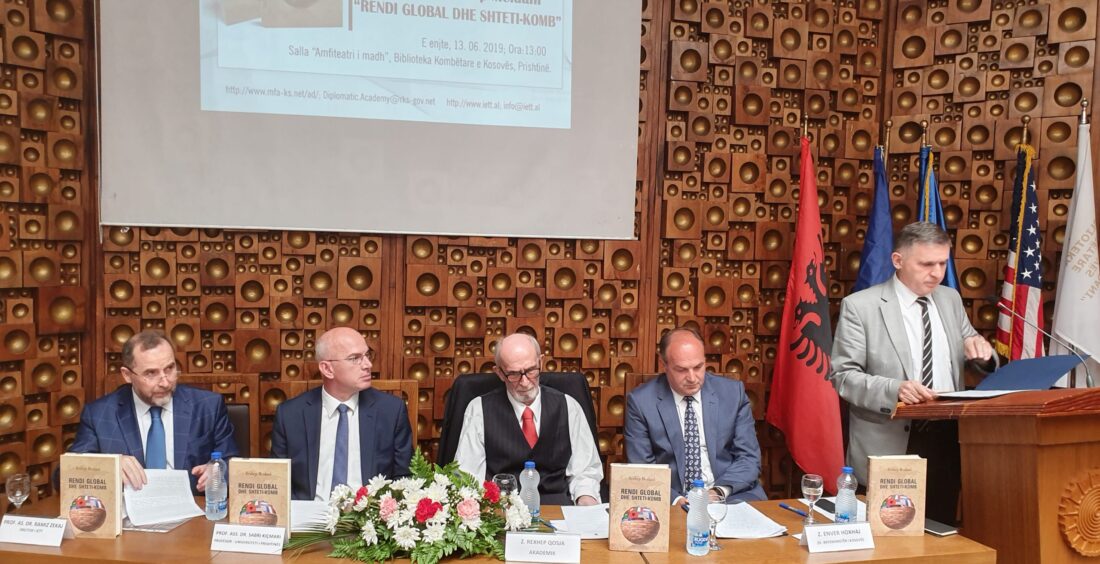
The Diplomatic Academy – Ministry of Foreign Affairs of Kosovo and the Institute of Education, Heritage and Tourism in Albania organized the promotion ceremony of the book “Global Order and the Nation-State” by academician and politician Rexhep Meidani, held at the National Library of Kosovo in Pristina.
Present at the event were the Deputy Prime Minister of Kosovo, Mr. Enver Hoxhaj; Academician Rexhep Qosja; the President of the Diplomatic Academy of Kosovo, Prof. Dr. Beqir Ismaili; Ambassador Sabri Kiçmari; the President of the Academy of Sciences of Albania, Academician Skënder Gjinushi; the Director of IETT, Assoc. Prof. Dr. Ramiz Zekaj; Ambassador Gazmend Pula; the Deputy Minister of Foreign Affairs of Kosovo, Mr. Çerkin Dukolli; the Rector of the University of Pristina, Prof. Dr. Marjan Dema, and others.
Drawing also from his valuable experience as President of the Republic of Albania during the period 1997–2002, Academician Meidani deemed it necessary to carry out this extensive study, which highlights the complex relationship between the phenomenon of globalization and the nation-state. “Global Order and the Nation-State” builds on his earlier work “The Traps of the Nation-State,” published in 2005, but now comes enriched with another major topic: globalization, along with a series of themes, issues, phenomena, agreements, and disagreements concerning these matters.
The welcoming speech was delivered by the Director General of the Diplomatic Academy of Kosovo, Prof. Dr. Beqir Ismaili. Then, the Deputy Prime Minister of Kosovo, Mr. Enver Hoxhaj, spoke, valuing the messages conveyed in the book through the treatment of a highly debated issue in today’s world.
Academician Rexhep Qosja, considering globalization a threat not only to our national culture but also to humanity as a whole, emphasized in his review that Rexhep Meidani’s work “Global Order and the Nation-State” belongs to the category of major, seminal works — those rare but profoundly enriching contributions to national identity and historical consciousness, filled with ideas, reflections, stimuli, inspirations, data, and energy for both the present and future history. What elevates this work is the author’s broad and universal culture and his rich creative experience. The book is also distinguished by its extensive political, social, cultural, and historical data, covering a wide geographical and temporal range, upon which the author explains the relations between globalization and the nation-state.
Ambassador Sabri Kiçmari, in a critical analysis of the book, stressed that President Meidani’s book is not the typical memoir of a former president. Former presidents usually write memoirs and rarely engage in theoretical analysis. However, in this book, we find deeply analytical, philosophical, and theoretical thought, well-structured and substantial. President Meidani’s concept is close to the explanations of Immanuel Kant, who, in explaining the notion of the nation, considers two main features — the civic community of people and their origin; and also close to the views of the German sociologist Max Weber, according to whom “the idea of the nation encompasses a community with a common origin and essential similarity.” Like Weber, Professor Meidani does not equate the nation with the state and the political community.
The Director of IETT, Assoc. Prof. Dr. Ramiz Zekaj, valued it as an academic work that marks a significant scholarly achievement in Albanian studies on global developments. According to him, Professor Meidani, in this book, successfully directs the political, philosophical, and social argumentation regarding the nation and the state, religion and secularization, nationalism, and more. The author provides an in-depth treatment of a topic that is both historical and very contemporary. Professor Zekaj also noted the maximum recognition the book “Global Order and the Nation-State” received during the 11th edition of the AIITC Prize in Tirana, where it was honored with a special award with the motivation: “An important philosophical-political work that deeply and originally addresses fundamental concepts of national and state life, viewed through historical experience and the perspective of the development of Albanian society.”
A greeting was also delivered by the President of the Academy of Sciences of Albania, Mr. Skënder Gjinushi.
The author himself expressed his gratitude to the publishing house “Mileniumi i Ri,” to IETT for financially supporting the publication, to the organizers of the promotion event, and to all participants. He also expressed appreciation for the positive evaluations his work received in Pristina, exceeding his expectations and being warmly welcomed by a wide range of scholars and readers.